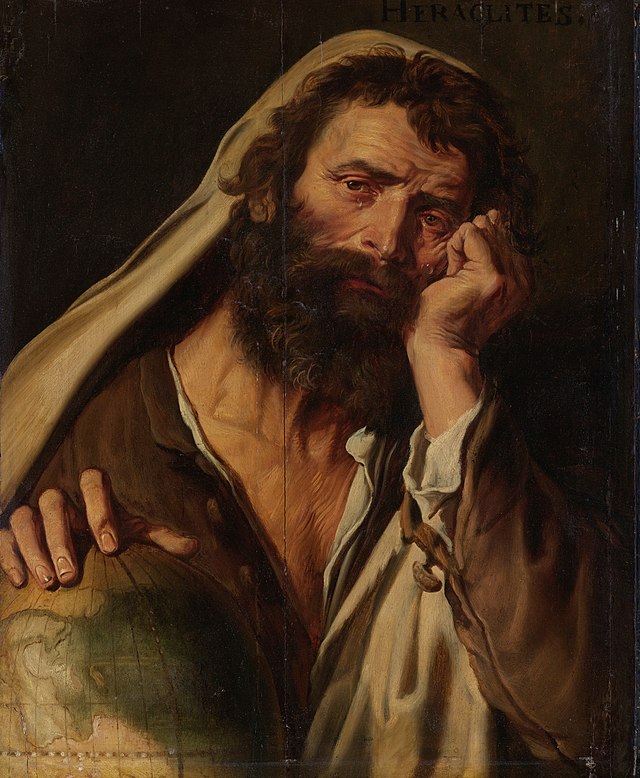
The Generative Conflict
Heraclitus's claim is not a celebration of violence. It is a metaphysical observation: everything that exists is the result of opposing forces held in tension. The hot and the cold, the wet and the dry, the waking and the sleeping — these opposites are not enemies to be reconciled but the constitutive poles of existence. Remove the tension and you remove the thing itself. A bow that cannot be drawn is not a bow; a lyre whose strings are slack has no music.
War is the father and king of all, and has produced some as gods and some as men, and has made some slaves and some free.
Bow and Lyre
Heraclitus returns to the image of the bow and the lyre to illustrate harmony through opposition. Both instruments depend on tension — the pull of the string against the frame — to function. Their "peace" would be their uselessness. The hidden harmony that runs through opposites is, he insists, better than the obvious harmony of things that simply agree. Dissonance, properly understood, is a form of order.
They do not understand: how that which separates unites with itself. It is a harmony of oppositions, as in the case of the bow and of the lyre.
Beyond Good and Evil
This view has disturbing implications. If strife is the father of all things, then the moral impulse to eliminate conflict — to achieve a final peace, a permanent resolution — misunderstands the nature of reality. Heraclitus seems to have believed that a world without tension would not be a better world but no world at all. Nietzsche, who admired Heraclitus above all other pre-Socratics, drew exactly this conclusion: the will to eliminate suffering and opposition is, in the end, the will to eliminate life itself.
Heraclitus's Fragment 44, in which war is named king and father, deeply disturbed ancient readers who heard it as a glorification of violence. But the Greek word polemos — war — had a broader range than its English counterpart; it could mean opposition or strife more generally. The fragment is better understood as a claim about the structure of reality than as a political endorsement.